We've spent this series making one case from four angles: the harness beats the model, here are the tools, here's how to tune one, and here's the minimal one worth studying. This closer is for whoever signs off on the AI budget.
Because if the harness is where results are decided, then most organizations are optimizing the wrong variable. They're in meetings about which model to standardize on. The more useful meeting is about the harness — and it changes the strategy.
Where the value actually accrues
Models are becoming a commodity. They're powerful, they're improving, and they're increasingly interchangeable — a good harness can swap one for another with a config change. What doesn't commoditize is everything around the model: the accumulated rules, the enforced guardrails, the tuned loops, the institutional knowledge encoded in your instruction files and hooks.
That's the strategic point. The durable asset isn't the model you rent — it's the harness you build around it. A competitor can buy the same model tomorrow. They can't buy the two years of earned rules, ratcheted failures, and workflow fit that make your agents reliable. Value accrues to the layer you own, not the one you subscribe to.
flowchart TD
  A["Your workflows, rules, hooks, skills<br/>— you OWN this (the moat)"] --> B["Harness runtime<br/>— buy / adopt a mature one"]
  B --> C["Model<br/>— rent, swap any time"]
Build, buy, or compose
This reframes the classic question. It's rarely a clean build-versus-buy — it's usually compose:
- Buy the runtime. Nobody should write an agent loop from scratch. Adopt a mature harness — Claude Code, Codex, Pi, whichever fits — as your foundation.
- Build the layer that's yours. The instruction files, hooks, skills, and workflows encoding how your business actually operates. This is the part worth real investment, because it's the part that compounds.
- Watch the lock-in. A whole category — harness-as-a-service — is forming to sell pre-built loops. Convenient, and often the right call. Just make sure the configuration you invest in is portable, so a vendor's pricing change or discontinued tier is an inconvenience, not a crisis. (Google's individual users learned that distinction the hard way in 2026.)
The teams getting this right treat the harness like infrastructure they own, running on models they rent.
The dependency risk nobody prices in
One sober note for anyone standardizing on a single vendor. In 2026, a generous free tier for individual developers vanished on a few weeks' notice while enterprise access continued untouched. That's not a scandal — it's a reminder. Your AI capability now depends on a stack of vendor decisions about pricing, availability, and models that can change without your input.
The mitigation isn't paranoia; it's design. Provider-agnostic harnesses, portable configuration, and the ability to switch models are cheap insurance against a supplier decision you don't control. Build so that swapping a model is a Tuesday, not a project.
The questions a leader should actually ask
Swap the meeting agenda. Instead of "which model are we using," ask:
- What's our harness, and who owns it? If the answer is "whatever the tool gives us by default," you're renting your capability, not building it.
- What have we encoded? Are our conventions, guardrails, and hard-won lessons captured in instruction files and hooks — or living in people's heads?
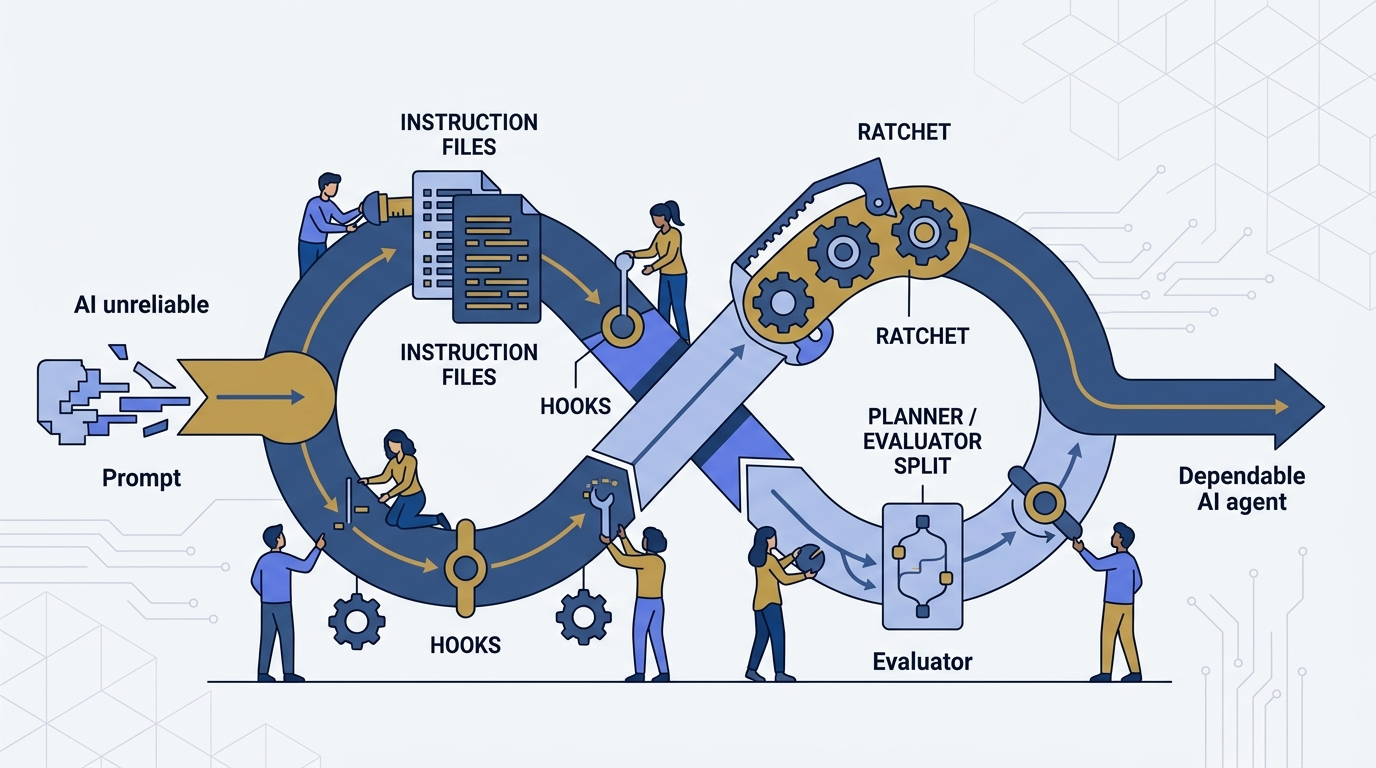
- Does our system learn? When an agent makes a mistake, does a rule get added so it never recurs (the ratchet), or do we just fix it and forget?
- How locked in are we? Could we switch models or tools next quarter without a rewrite?
- Who reviews the agent's work? Is there a real check — a separate evaluator, a human gate on risky actions — or are we trusting the agent to grade itself?
Answer those honestly and you'll know exactly how mature your AI capability is — far better than any benchmark or model name could tell you.
The bottom line
The harness era rewards a specific kind of organization: one that treats AI agents as systems to be engineered and owned, not products to be bought and trusted. The model is the engine, and engines are for rent. The harness is the vehicle, the road rules, and the driver's training — and that's the part that carries your business.
At HarmonyX, this is how we build and deploy agentic systems for our clients: mature runtimes underneath, a harness engineered around each business on top, and no dependency we can't swap out. If you're trying to move an AI pilot into dependable production, the harness is where that work actually happens — let's talk.
This concludes our five-part series on the AI harness era. Start from the beginning: Agent = Model + Harness.