In our first post we made the case that the harness — not the model — decides most of what you get from an AI agent. So the obvious next question: which harness?
By mid-2026 the answer had sorted itself into a handful of clear camps. They run on different models, charge in different ways, and disagree about how much the tool should do for you versus leave to you. Here's the map.
The complete runtime: Claude Code
If there's a default for teams doing serious multi-file engineering, this is it. Claude Code is the most complete agentic runtime in wide use — and its harness features are the reason, not just the model underneath.
It reads a CLAUDE.md file that persists across every session, carrying your conventions, architecture, and business rules. Hooks (PreToolUse, PostToolUse) let you inject deterministic logic before or after any action — run a linter, block a command, log a change. Worktrees let it work several isolated branches in parallel, and its team features coordinate multiple agents. Paired with a million-token context window on its top model, it handles large codebases without losing the thread.
Fits: teams that want power and control, and will invest in configuring it. Cost: from a $20/month plan up to $100–200/month tiers, or pay-per-token via API.
The autonomy machine: Codex CLI
Where Claude Code emphasizes control, Codex CLI emphasizes letting go. Its Goal mode runs for hours without supervision, and it's built for headless, hands-off operation — native GitHub Actions support and a --full-auto execution mode.
Its instruction file is AGENTS.md — an open format now adopted well beyond Codex — used to encode what to check, from deprecated APIs to security-sensitive patterns, with structured diff-level output that drops cleanly into merge requests. If your goal is agents running inside CI rather than beside a developer, this is the strong pick.
Fits: automation-heavy pipelines, long unattended runs. Watch: the flagship model is pricier per token; a cheaper mini model exists for routine work.
The transition case: Google's Antigravity
Google's individual-developer story changed abruptly in 2026. The generous free Gemini CLI tier for individuals ended in June, replaced by Antigravity CLI — written in Go, sharing architecture with the Antigravity desktop app, and built around asynchronous multi-agent workflows.
The lesson here is less about features than about dependency risk: an individual free tier vanished on a few weeks' notice while enterprise access continued. Worth remembering when you standardize a team on any single vendor's harness.
The minimal challenger: Pi
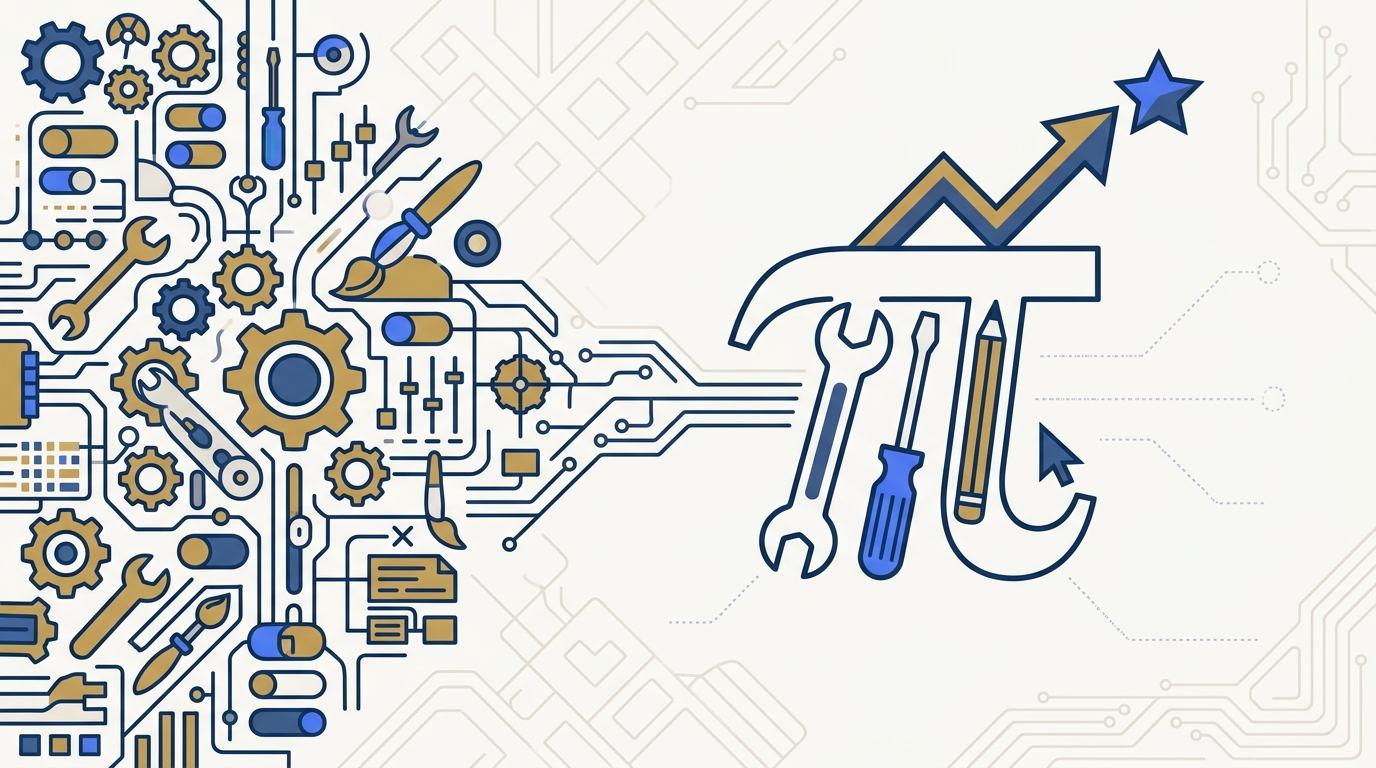
The most interesting arrival is the smallest. Pi (pi.dev), from libGDX creator Mario Zechner, is an open-source (MIT) harness built on one thesis: a coding agent needs exactly four tools — read, write, edit, bash — and a system prompt under 1,000 tokens. Everything else is opt-in.
No built-in sub-agents, no plan mode, no bundled MCP. Instead, a typed TypeScript extension system lets you add exactly the behavior you want and share it as a package over npm or git. It's provider-agnostic — the same loop runs against Anthropic, OpenAI, Google, local models via Ollama, 15+ providers — with model switching mid-session. By June 2026 it had passed 62,000 GitHub stars. We give Pi its own post later in this series; for now, file it as the harness you reshape around your workflow instead of the reverse.
Fits: teams that want to own their harness, avoid lock-in, or run local models. Cost: free and open source; you bring your own model keys.
The rest of the pack
- Cursor — the harness fused into an editor rather than a terminal, strongest for developers who want AI woven into an IDE.
- Aider — a lean, terminal-native open-source agent with a devoted following, especially for tight Git-centric loops.
- OpenCode — another open contender in the reshape-it-yourself camp alongside Pi.
How to actually choose
The tools matter less than matching one to how your team works. A rough guide:
| If you want… | Look at |
|---|---|
| Maximum control on big codebases | Claude Code |
| Unattended automation in CI | Codex CLI |
| To own and reshape the harness | Pi, OpenCode, Aider |
| AI inside your editor | Cursor |
One pattern cuts across all of them, and it's the real headline: these tools increasingly resemble each other under the hood, despite completely different models. They're all converging on the same load-bearing harness patterns — persistent instruction files, hooks, context compaction, sub-agent orchestration. That convergence is your signal. Learn the patterns once and they transfer, whichever tool you land on.
Part two of our series on the AI harness era. Next: loop engineering — the patterns teams use to actually tune a harness, from AGENTS.md discipline to the ratchet.