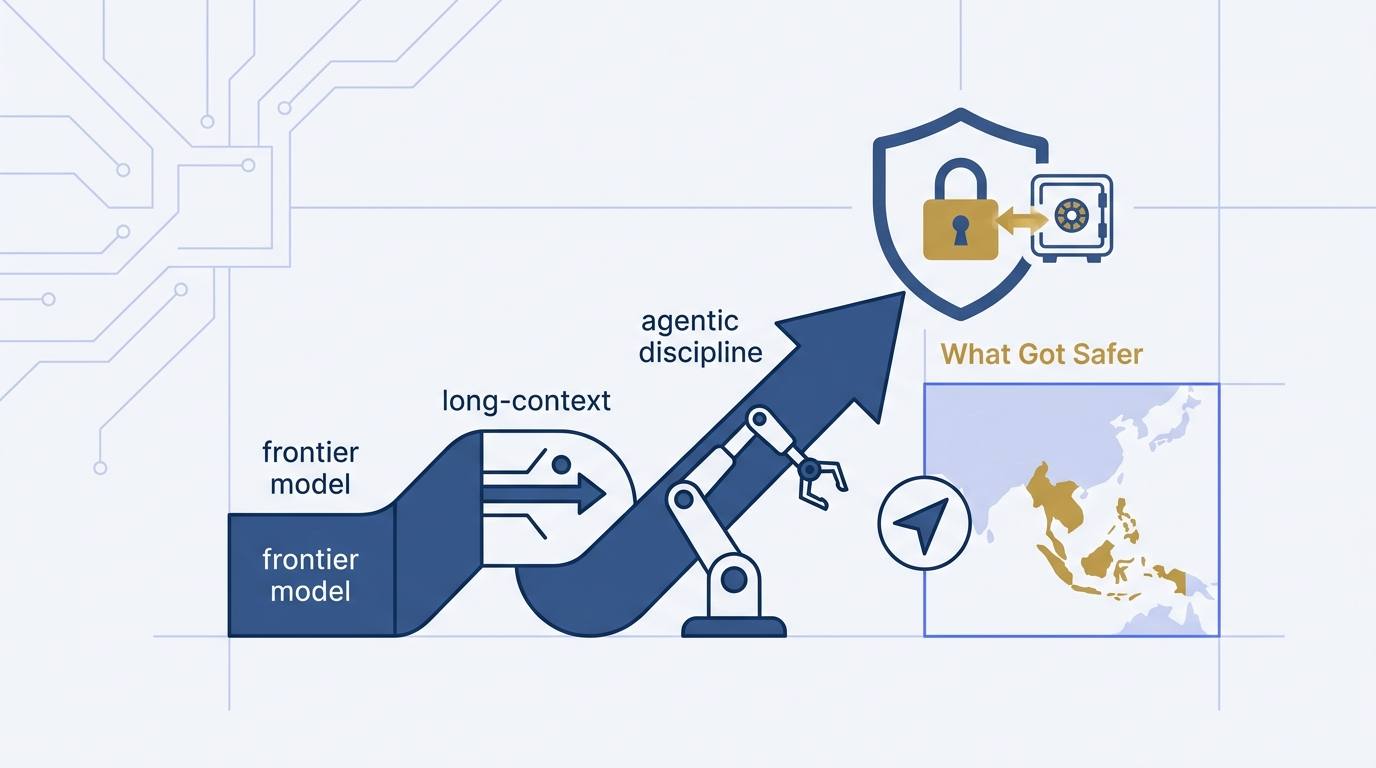
In plain terms: April 2026 had no single dramatic AI headline — but enough things shifted at once that the right questions for engineering teams changed. The leading models from Anthropic, OpenAI, and Google got better and cheaper to run. Long-context windows (the amount of text a model can read in one go) became practical for real work, not just demos. And regulators started enforcing the rules they wrote last year. This post is a focused recap of what changed and one concrete recommendation for engineering teams shipping AI.
April 2026 was a productive month for AI infrastructure — not in the sense of a single dramatic announcement, but in the accumulation of capability, governance, and operational discipline that separates teams who ship AI reliably from those who ship it hopefully. Frontier models got more capable and slightly cheaper to run. Long-context windows became genuinely production-ready rather than a benchmark talking point. Agentic systems matured enough that the discipline around them — observability, eval harnesses, replay logging — stopped being optional. And regulators moved from policy drafting to enforcement. For engineering leaders, the relevant question is not whether these shifts matter. It is which ones demand action before the next sprint.
What follows is a digest, not a press release. We cover the model landscape, infrastructure economics, agentic patterns, safety developments, regulatory state, and close with one concrete recommendation for teams running AI in customer-facing or financial workflows. No speculation about future releases. No vendor advocacy. Just the operational signal that matters.
Frontier model landscape
Anthropic's current generation — Claude Opus 4.7, Sonnet 4.6, and Haiku 4.5 — marks a meaningful step in instruction-following consistency, especially across multi-turn agentic tasks and structured-output generation. Sonnet 4.6 in particular has become a workhorse for enterprise teams: strong enough for most production tasks, fast enough for interactive latency requirements, and priced at a tier that makes high-volume customer-facing use economically defensible. Opus 4.7 handles the cases that require extended reasoning — contract analysis, multi-document synthesis, and adversarial prompt robustness. Haiku 4.5 fills the classification and routing tier where token cost dominates. The net effect is a coherent three-tier architecture that most teams can map directly to their workflow layers without custom fine-tuning.
GPT and Gemini continue on their respective roadmaps. The practical observation worth noting: the gap between frontier proprietary models and the leading open-weight Llama-class models has narrowed significantly on practical workloads — document extraction, code generation, retrieval-augmented generation — while the frontier edge remains on complex multi-step reasoning and adversarial robustness. For teams evaluating open-weight deployment on-premises or via managed inference for data-residency reasons, April's releases suggest the capability case is now reasonable for a broad class of enterprise tasks.
Long-context is no longer a benchmark — it is a product
One-million-token context windows shifted from a marketing figure to a genuinely usable production capability during April. Three use cases are proving out at scale. First, codebase reasoning: feeding a full repository into context for architecture review, bug triage, or impact analysis — without chunking or pre-retrieval. Second, legal and compliance document review: ingesting a full contract stack, regulatory filing, or vendor agreement corpus in a single call. Third, multi-document RAG (Retrieval-Augmented Generation — the pattern of pulling source material from a knowledge base and feeding it to the model alongside the user's question) where the retrieval step is intentionally coarse — retrieve more, reason across all of it, rather than precision-retrieve a handful of chunks.
The tradeoffs are real and teams should model them explicitly. At 1M tokens, time-to-first-token latency is measurable seconds even on optimised inference endpoints. Cost per call scales linearly with input tokens — a 500k-token codebase review costs more than 50 individual 10k-token queries. The right architecture depends on query frequency and latency tolerance. For batch workflows run overnight or on-demand, full-context is often the simpler and more accurate choice. For interactive flows, a well-tuned retrieval step is usually preferable.
Agentic AI: tool-use reliability and the discipline of observability
Tool-use reliability — the consistency with which a model correctly selects, parameterises, and sequences tool calls — continues to improve, and April's releases push the practical threshold for production deployment further than it was six months ago. Computer-use modalities, where agents interact with desktop and web interfaces directly, are graduating from demo territory into controlled internal-tooling deployments. The headline is not the capability. It is the operational discipline that responsible teams now apply around it.
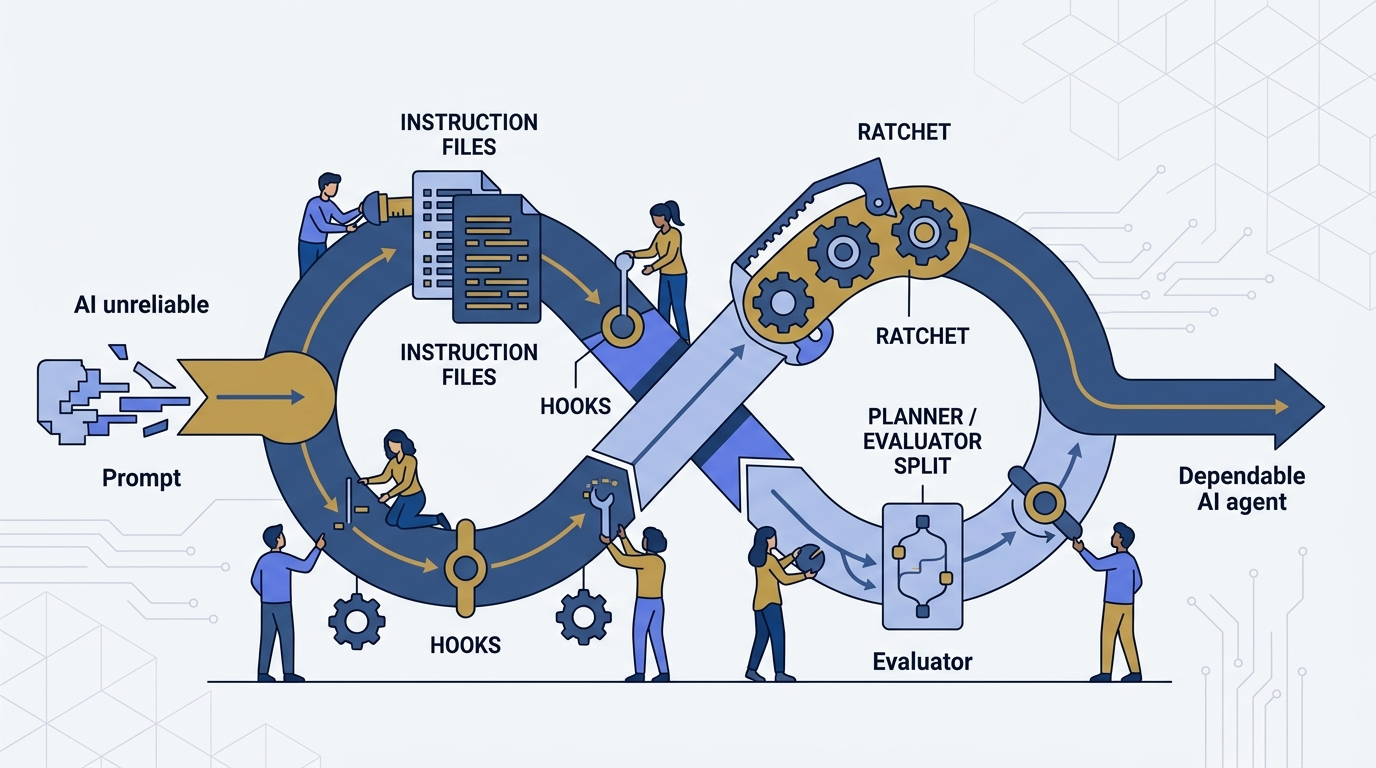
Agent observability — the practice of logging every tool call, recording the reasoning trace, enabling replay, and running eval harnesses on sampled agent trajectories — is no longer optional for any system that touches customer data or financial operations. The teams doing this well have three things in place:
- Structured tool-call logs with input parameters, model reasoning, output, and latency captured at every step — not just final outputs
- Eval harnesses run on a sample of real production trajectories each release cycle — not just synthetic test sets — so regressions surface before they reach users
- Human-in-the-Loop checkpoints defined by policy — not by whether the engineer thought to add one — with escalation paths that trigger automatically on confidence thresholds or ambiguous tool-selection patterns
AI safety: prompt injection, supply-chain risk, and the working frameworks
Prompt injection remains the most exploited class of LLM vulnerability in production deployments. The attack surface has expanded as agentic systems retrieve content from external sources — emails, documents, web pages — that may contain adversarial instructions. Indirect prompt injection, where the malicious instruction is embedded in retrieved content rather than the user's direct input, is the pattern that catches teams off-guard. Jailbreak resistance has improved in frontier models, but the arms race continues. Supply-chain integrity — the provenance and integrity of model weights, quantised variants, and inference runtime components — is a concern that most enterprise security teams have not yet formalised.
Two frameworks have emerged as the practical baseline for teams doing structured AI security work. OWASP LLM Top 10 covers the application-layer threat surface: prompt injection, insecure output handling, training data poisoning, model denial-of-service, sensitive information disclosure, insecure plugin design, excessive agency, model theft, overreliance, and supply-chain vulnerabilities. MITRE ATLAS extends the adversarial ML taxonomy to cover attack patterns across the full model development and deployment lifecycle. Neither is a compliance checklist. Both are working tools for threat modelling, red-team scoping, and control prioritisation.
Prompt injection is not a model problem — it is an architecture problem, and the fix is in how you design the boundary between trusted instructions and untrusted retrieved content.
Regulatory: EU AI Act enforcement, ISO/IEC 42001, and global data residency
The EU AI Act has passed its implementation phase and enforcement activity is starting to generate concrete precedent. High-risk system classifications — covering AI used in credit decisions, hiring, healthcare diagnostics, law enforcement, and critical infrastructure — now carry active audit obligations in EU-facing deployments. For organisations with EU operations or data flows touching EU residents, the practical implication is that the Conformity Assessment and Technical File requirements are not future preparation — they are present obligations.
ISO/IEC 42001, the AI management system standard, is gaining adoption as a structured governance layer — essentially an Information Security Management System (ISMS)-style framework applied to AI development and deployment, where the audit discipline that ISO 27001 brings to security gets extended to model behaviour, data lineage, and AI-specific risk. For organisations that have already implemented ISO 27001, the extension is logical: shared control families, similar audit discipline, and a clear mapping to regulatory expectations in multiple jurisdictions. Teams pursuing ISO/IEC 42001 certification are finding that the inventory and risk-classification work required by the standard aligns directly with EU AI Act compliance groundwork.
On data residency: GDPR in Europe, the UK Data Protection Act, US state laws like the CCPA, and PDPA-class regimes across Thailand, Malaysia, Indonesia, and Singapore all impose constraints on where personal data used in AI training and inference may be processed. Managed inference platforms — Bedrock, Vertex, and Azure OpenAI — have expanded their regional endpoint coverage, making in-region processing more straightforward. The operational requirement is explicit documentation of which data flows cross jurisdictional boundaries, which Sub-Processor agreements cover model vendors, and what the lawful basis is for each processing activity.
Infrastructure: inference cost curves, on-device, and managed platform maturity
Inference costs continue their multi-year downward trend. The practical effect for enterprise teams is that use cases which were cost-impractical eighteen months ago — per-document processing at scale, real-time personalisation, high-frequency classification — are now routinely viable. The cost floor is still meaningful: high-volume, latency-sensitive production workloads require careful model selection and prompt engineering discipline. But the structural trend is clear, and budgets should reflect it.
On-device inference is improving for sensitive workloads. Smaller quantised models running locally — on enterprise laptops, managed devices, or edge hardware — are now capable on classification, summarisation, and lightweight generation tasks. For workloads where data must not leave the device, the capability gap versus cloud inference has closed enough to warrant evaluation. Managed inference platforms — Bedrock, Vertex, and Azure OpenAI — have all made meaningful governance improvements: request-level audit logging, model version pinning, fine-grained access control, and regional endpoint expansion. For enterprise teams that need auditability and policy compliance, the managed path is now the lower-friction option.
Open-weight models: the capability and the caution
Llama-class models and their derivatives continue to close the capability gap on practical enterprise tasks. The case for open-weight deployment — data residency control, no per-call API cost at scale, fine-tuning on proprietary data — is now backed by real production evidence across the industry. The cautions remain: supply-chain integrity for model weights downloaded from public registries is non-trivial to verify; adversarial robustness and jailbreak resistance lag frontier proprietary models; and the operational overhead of running your own inference infrastructure is a real cost that teams frequently under-estimate. The right answer depends on workload, data classification, and team capability — not on ideology.
The one thing engineering teams should do differently starting now
Adopt eval-in-CI for every AI feature that touches customer or financial workflows. Not as a compliance ritual — as the only reliable signal for whether a model upgrade, prompt change, or retrieval modification actually improved or degraded behaviour in your specific production context. Benchmark scores and vendor release notes do not tell you this. Your own eval suite, run against a golden set of production-representative trajectories on every significant change, does.
The practical shape of this is not complex. A golden test set of 50–200 real or realistic production traces. An assertion layer that checks outputs against expected behaviour — not just format correctness, but semantic and safety properties. A CI step that runs the full eval on pull requests touching prompts, RAG configuration, model version, or tool definitions. Failure blocks merge. Pass means the change is safe to ship. Teams that have this in place ship model and prompt updates weekly without incident. Teams that do not discover regressions through customer complaints.
- Start with your highest-risk workflow — the one where a wrong answer has a material cost — and build the eval suite there first
- Use Promptfoo, LangSmith, or a lightweight custom harness — the tooling choice matters less than the discipline of running it on every relevant change
- Include adversarial cases in the golden set — prompt injection attempts, edge-case inputs, and the failure modes your red-team identified — so safety regressions are caught in CI, not in production
What to watch in May
Three signals worth tracking in the month ahead: EU AI Act enforcement actions — the first penalty decisions will establish concrete precedent for what adequate compliance looks like in practice. ISO/IEC 42001 certification timelines — the number of accredited certification bodies is growing globally and lead times are extending, so teams considering certification should start the scoping conversation now. And open-weight model governance — the question of how to verify supply-chain integrity for open-weight deployments is moving from academic to operational as enterprise adoption scales.
Stay current
We publish this monthly AI digest alongside deeper technical posts on AI engineering, governance, and infrastructure at harmonyx.co/blog. If your team is building or operating AI systems and wants a review of your observability setup, eval discipline, or AI governance posture, the HarmonyX AI engineering practice works on exactly these engagements. Follow the blog or reach out directly — next month's digest will cover whatever actually ships and matters in May.