Agentic AI is past the pilot stage. Gartner expects 40% of enterprise apps to embed AI agents by 2026 — software that plans, decides, and acts without a human kicking off each step. Companies that filed this under "future problem" are already trailing the ones that shipped in 2024.
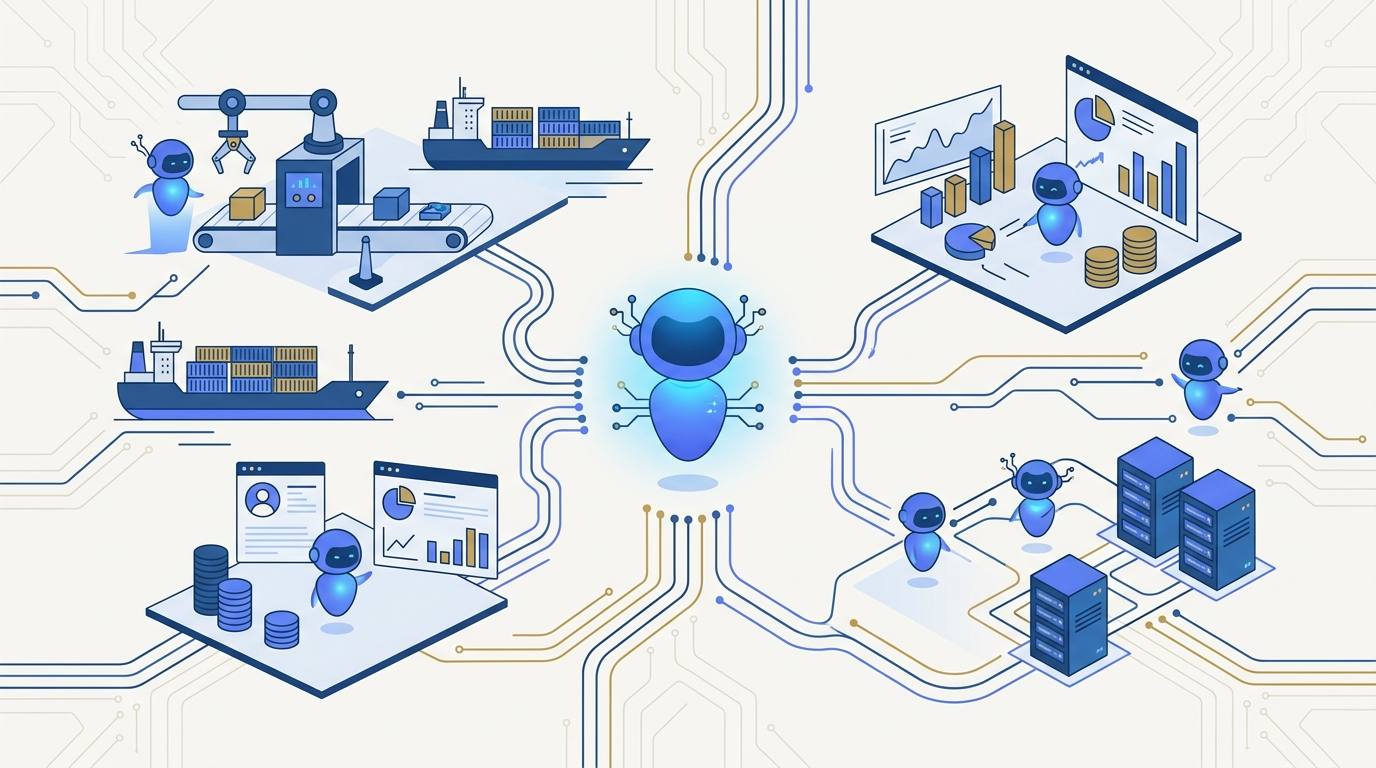
The shift is structural. Instead of bolting an AI feature onto an old workflow, companies now run multi-agent systems — teams of agents that coordinate across sales, supply chain, finance, and HR at the same time. These agents do not just answer questions. They negotiate purchase orders, reconcile accounts across countries, and reroute shipments in real time when things break. The leverage is real. So is the blast radius if you wire it up wrong.
What makes Agentic AI different from classical automation?
flowchart LR
  U[User / Trigger] --> O[Orchestrator]
  O --> P[Planner]
  P --> S1[Specialist Agent A]
  P --> S2[Specialist Agent B]
  S1 --> T[Tools / APIs]
  S2 --> T
  S1 --> M[(Memory & RAG)]
  S2 --> M
  S1 -.review.-> H[Human-in-the-loop]
  S2 -.review.-> H
  H --> O
  T --> O
Classical automation runs a fixed sequence of steps. An agent reasons about the goal, picks a tool, hands work to other agents, and rewrites its plan when conditions change. That difference matters: an RPA bot breaks the moment the UI shifts; an agent adapts. The capability rests on three parts — a large language model as the reasoning core, a set of callable tools (APIs, databases, code interpreters), and a memory layer (often paired with RAG, short for retrieval-augmented generation) that keeps context between sessions.
For a CFO or COO, the practical win is that agents can own a process end-to-end, not just one step inside it. A procurement agent can spot a supply shortfall, source three alternative vendors, compare landed cost, draft a purchase order, and route it for approval — all before an analyst has finished reading the alert.
Where are enterprises deploying agents today?
Across production deployments globally — and our own client portfolio in North America, Europe, and Asia — four domains are moving from pilot to production fastest right now.
- Financial operations — agents handle accounts-payable matching, FX exposure alerts, and regulatory filing drafts across jurisdictions, cutting a four-day month-end close to same-day.
- Supply chain and procurement — agents watch supplier lead times, customs data, and inventory in parallel, then surface reorder decisions with evidence attached, not raw alerts.
- Customer operations — agents handle Tier-1 and Tier-2 support across email, web chat, and regional messaging at the same time. Escalation rules know when a human must step in instead of guessing.
- Compliance monitoring — agents continuously scan circulars from the SEC, FCA, MAS, and the Bank of Thailand, flag gaps against internal policy, and draft a remediation brief.
The bottleneck is no longer the model. It is the architecture around the model — guardrails, observability, and a human checkpoint at exactly the right places.
Why most enterprise agentic pilots stall before production
We have reviewed dozens of stalled agentic projects in the past twelve months across North America, Europe, and Asia-Pacific. The failure pattern is almost always the same: a strong foundation model, a thin integration layer, no observability, and no guardrails. The agent looks great in demos. It hallucinates in production. Worse — nobody knows it is hallucinating, because there is no audit trail.
Here are the five architectural requirements we enforce before any agentic system goes live with our clients.
- Observability from day one. Log every agent action, tool call, and reasoning step as a structured trace — not just the final output.
- Guardrails at the tool layer. Not soft instructions in the prompt — hard constraints on which APIs the agent can call, with what parameters, and up to what dollar threshold.
- Human-in-the-loop escalation — explicit rules that pause the agent and route a decision to a named human role. Not the model's discretion.
- An immutable record of every agent decision. Critical in regulated industries — examiners at the SEC, FCA, MAS, or the Bank of Thailand may ask you to reconstruct exactly how a financial decision was made.
- Model registry with drift monitoring. The model you tested in Q1 may not be the one the vendor ships in Q3. Your guardrails must adapt — or at least alert.
How do you evaluate the ROI of an agentic deployment?
Measure ROI on three horizons. Short term (0–6 months): hours of manual work removed per week, plus error-rate reduction in the target process. Medium term (6–18 months): cycle-time compression — how many days did you take out of month-end close, procurement lead time, or customer resolution? Long term: competitive optionality — can you launch a new product, enter a new market, or absorb a regulatory change without growing headcount? McKinsey estimates AI automation of knowledge-work tasks could unlock $4.4 trillion in annual productivity globally, with financial services, supply chain, and customer operations among the highest-capture sectors.
What should your first agentic production system look like?
Start narrow. Instrument everything. Pick one high-volume, low-variance process — invoice matching, first-response triage, or daily inventory review. Build the full observability and guardrail stack around a single agent before you expand. This way your team learns the failure modes before the system touches high-stakes decisions. It also gives you a clean evidence base — when the board or a regulator asks how the agent decided last Tuesday, you can show them, line by line.
The path from a single narrow agent to a multi-agent enterprise fabric usually takes 12–18 months when the foundation is right. Teams that skip the foundation spend those months firefighting production incidents instead.
References
gartner.com Gartner Agentic AI enters the Trough of Disillusionment (2025 Hype Cycle for Artificial Intelligence) mckinsey.com McKinsey Global Institute The economic potential of generative AI: The next productivity frontierScoping your first agentic production system, or adding observability and guardrails to an existing one? HarmonyX builds and operates agentic infrastructure for enterprise clients globally, with deep operations across Thailand and ASEAN. Reach us via the contact page or explore the practice at /products/agentic-ai — we are happy to run a one-hour architecture review before you commit.